Mean Motion Resonances & Planetary Conjunctions
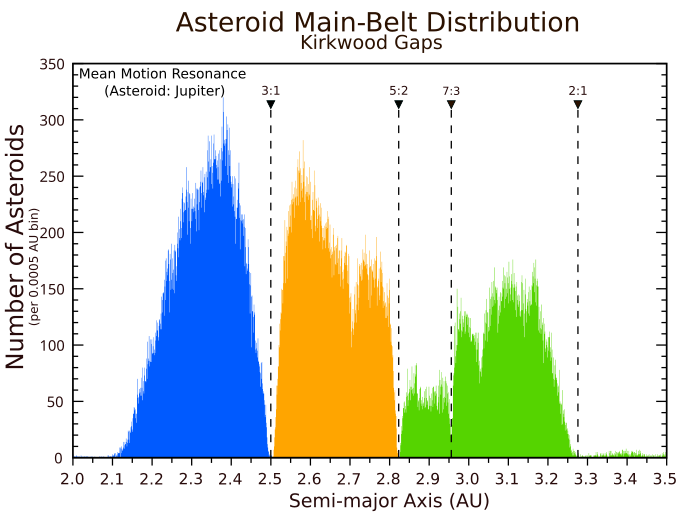
Kirkwood gaps in the main asteroid belt
In our Solar System, Neptune orbits the Sun three times for every two orbits of Pluto. Such an integer ratio between a pair of orbital periods is called a mean motion resonance (MMR), so we say that Neptune and Pluto are in a 3:2 MMR. Much more than a simple coincidence, such MMRs act as a double-edged sword that in some scenarios orchestrate a stable, repeating clockwork dance, while in others they drive chaos and dynamical instabilities.
The crossing orbits of Neptune and Pluto provide an example of a stabilizing MMR. If their angular frequencies had no relationship to one another, eventually the two bodies would by chance end up at the same location at the same time and collide. However, the MMR synchronizes their motion so that the two never meet at the same place; it ensures that the faster Neptune always overtakes Pluto near the azimuthal location where the two orbits are maximally separated. As a result, the planets never risk close approaches or collisions, so here the resonance acts to stabilize the system.
On the other hand, Kirkwood gaps in the Asteroid belt illustrate the destabilizing effects of MMRs. (See figure to the left.) Ultimately, the reason why MMRs play an outsized role in orbital dynamics is the fact that they make it possible for small gravitational perturbations to repeat, so that they build up coherently and lead to large cumulative effects.
In general, an MMR occurs when two planets orbit a star with orbital periods that form an integer ratio, such as 3:2 or 5:3. But one can imagine infinitely many possible integer period ratios along the semi-major axis range on the x-axis in the figure on the left. Why is it that only certain MMRs, e.g., the 3:1 are prominently vacated, and not, for example, the 11:4 MMR at 2.64 AU?
The answer is a well known result in orbital mechanics: the strength of a \(p:(p-q)\) MMR is proportional to \(e^q\) for low orbital eccentricities \(e\).
(Recall that for an elliptical orbit \(0 \leq e < 1\))
Due to the small eccentricities in the Solar System, MMRs are much weaker for large values of \(q\); because of this strength hierarchy, this parameter \(q\) is called the order of the resonance. This is why the most prominent Kirkwood gaps correspond to low-order MMRs: the 2:1 resonance—first order—truncates the outer edge of the asteroid belt, and we observe progressively smaller gaps for the second-order MMR (e.g. 3:1), third order (e.g. 5:2), and so on.
In the traditional orbital mechanics literature, the \(e^q\) MMR strength scaling derives from a sophisticated edifice of perturbation theory built up over hundreds of years. The central problem is that the gravitational interaction potential \(Gm_1m_2/r\) changes in a complicated way as the planets orbit at different rates and their interplanetary separation \(r\) varies.
In this thesis we instead provide a simple physical explanation for this result for closely spaced orbits. In this limit, interplanetary interactions are negligible except during close encounters at conjunction, where the planets impart a gravitational “kick” to each other's mean motion. For a \(q\)th order \(p:p-q\) MMR, the inner planet completes \(q\) more orbits than the outer planet each cycle. Since a conjunction occurs each time the inner planet overtakes the outer planet, there are \(q\) conjunctions per cycle. By considering previously known Fourier expansions for the magnitude of the kick at conjunction, we show that the \(q\)-fold symmetry in conjunction locations leads to a cancellation of terms up to order \(e^{q-1}\).
Using this geometric approach, we show that the weakness of high-order MMRs is due to the canceling effects of multiple conjunctions, and quantitatively explain their strength scaling as \(e^q\). In my thesis report (embedded below), we show how this physically intuitive picture provides additional insight on the structure of additional corrections beyond the leading order behavior, and discuss its regimes of applicability.